Water Extraction in New Palestine: Standing Water Removal Stories
Standing water inside your New Palestine home is not a problem that waits for business hours. Every minute that water sits on your floor, it pushes deeper into subfloors, drywall, baseboards, and insulation. By hour 24, you are no longer dealing with clean water. You are dealing with bacterial growth, swollen hardwood, and a Category 2 loss that costs significantly more to restore.
At New Palestine Water Restoration, we have been answering these calls across Central Indiana since 2018. We are BBB A+ rated, IICRC certified, and our trucks are loaded with truck mounted extractors that pull 100+ gallons per hour. If you are reading this with water around your ankles, stop scrolling and call us. If you have a few minutes and want to understand what is happening to your property and what professional extraction actually looks like, keep reading. We wrote this guide for the homeowner in New Palestine who is standing in a wet basement at 11pm wondering whether to grab a Shop-Vac or pick up the phone.
One promise before we start: if your situation does not need our crew, we will tell you directly. We would rather give you 10 minutes of honest advice than sell you a service you do not need.
The Problem: Standing Water Spreads Faster Than You Think
Water does not stay where you see it. The visible puddle in your New Palestine basement or kitchen is only the surface layer. Underneath, water is wicking up into drywall at roughly one inch per hour, soaking into the bottom plate of your wall framing, and traveling through hairline cracks in concrete slabs. Within four to six hours, materials that looked fine when you arrived are saturated.
This is why a Shop-Vac rarely solves the real issue. A consumer wet/dry vacuum pulls maybe 5 to 10 gallons before you have to empty it, and it does nothing for the moisture already trapped inside building materials. You can mop up the puddle and still lose your flooring three weeks later when the subfloor warps.
The spread is also lateral. Water follows the path of least resistance, which often means traveling under baseboards into adjacent rooms, down through floor vents into ductwork, or along the top of a foundation wall into an attached garage. A burst supply line in a second floor bathroom can soak three rooms on the main level by the time you notice the ceiling stain.
The Problem: Insurance Claims Get Denied for Poor Documentation
Homeowners often call us after trying to handle extraction themselves, then realize their insurance carrier wants moisture logs, photos, and a scope of work they cannot produce. Without that paperwork, claims get reduced or denied entirely. Carriers want proof that mitigation happened quickly and correctly, per IICRC S500 standards.
The Solution: Claim-Ready Documentation From Hour One
Every New Palestine Water Restoration job in New Palestine includes photo documentation of pre loss conditions, moisture readings logged daily, equipment placement diagrams, and a written scope that matches Xactimate line items your adjuster already uses. We bill insurance directly in most cases, so you are not fronting thousands of dollars while waiting for reimbursement.
We also coordinate directly with your adjuster on site visits and supplement requests, which cuts down on the back and forth that drags claims out for weeks. If you are still deciding whether to file a claim, our piece on the full water damage restoration cost breakdown gives you realistic numbers before you make that call. Most homeowners are surprised to learn that extraction and drying alone typically run $1,500 to $4,500, with full restoration ranging higher depending on materials affected.
The Solution: truck mounted Extraction Within the First Hours
Professional water extraction in New Palestine starts with equipment most homeowners never see. Our truck mounted units generate strong vacuum pressure and run continuously without filling tanks inside your home. For a typical flooded basement, we can pull thousands of gallons in a single visit.
Here is what the first response actually looks like when our crew arrives:
- Source identification and shutoff if the leak is still active, plus a safety scan for electrical hazards before anyone steps in standing water.
- IICRC category assessment (Cat 1 clean, Cat 2 gray, Cat 3 black) which determines what materials can be saved and what must be removed.
- Bulk extraction using truck mounted equipment, followed by weighted extraction tools on carpeted areas to pull water from padding.
Speed matters here. Insurance carriers look at response time when evaluating claims, and so does the building itself. For deeper context on timing and cost, our breakdown of emergency water removal response times and pricing walks through what to expect hour by hour.
The Solution: Moisture Mapping and Structural Drying
After extraction, our technicians use thermal imaging cameras and penetrating moisture meters to map every wet area in the affected space. This is not guesswork. We mark readings, document them for your insurance file, and create a drying plan based on the actual moisture content of your specific materials.
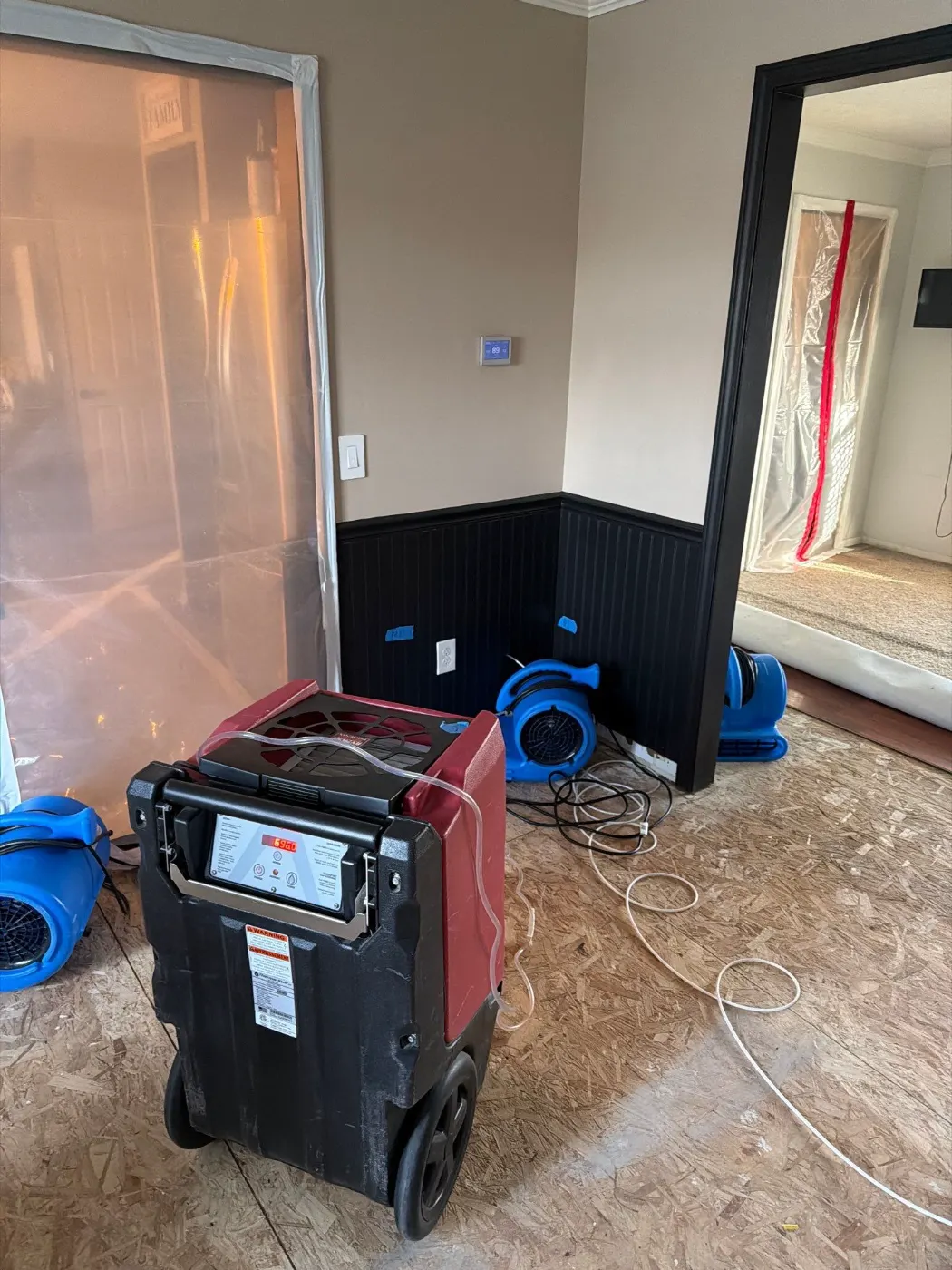
Structural drying typically involves three coordinated pieces of equipment working together:
- High velocity air movers positioned to push air across wet surfaces at calculated angles, usually one mover per 10 to 16 linear feet of wet wall.
- Commercial dehumidifiers (LGR or desiccant depending on conditions) sized to the cubic footage of the affected area.
- Daily monitoring with documented moisture readings until materials return to dry standard, usually three to five days for a clean water loss.
In some cases, we also drill small weep holes at the base of drywall to release trapped water in wall cavities, or pull a few feet of baseboard so air can reach the bottom plate directly. These targeted techniques save the rest of the wall and avoid a full tear out. If your loss involves a finished lower level, our guide on flooded basement cleanup and professional drying covers the specific challenges of below grade extraction in New Palestine.
The Solution: Call Now, Sort Details Later
Our phones are answered 24 hours a day by a real person in Central Indiana, not an offshore call center. We dispatch within 2 hours of your call across the New Palestine service area. You do not need to have your policy number, your deductible figured out, or a plan. You just need to make the call.
Get Water Out Before the Damage Sets In
Standing water is the one part of restoration where minutes matter more than money. If you are watching it spread across your New Palestine floor right now, the right move is to call a crew with truck mounted equipment and IICRC certification on the way. New Palestine Water Restoration answers the phone around the clock, gives you a straight assessment when we arrive, and tells you honestly if the job is something you can handle yourself. That is the standard we have held since 2018, and it is what we will give you tonight.
The Problem: Waiting Until Morning
The single most expensive decision a New Palestine homeowner makes is waiting overnight. Mold can begin colonizing wet drywall within 24 to 48 hours. Hardwood cupping becomes permanent after roughly 72 hours of saturation. Carpet padding rarely survives more than 48 hours of standing water in any category above Cat 1.
What looks like a manageable puddle at 10 p.m. is often a five figure restoration project by sunrise. The math almost never favors waiting.
The Problem: Hidden Moisture Behind Walls and Under Floors
Once the visible water is gone, most homeowners assume the worst is over. It is not. Drywall acts like a sponge and holds moisture against your wall studs. Engineered hardwood traps water between the planks and the subfloor where no fan can reach it. Tack strips, baseboards, and insulation all hold water that will continue to feed mold growth for weeks if untreated.
In New Palestine homes with finished basements, we routinely find moisture readings of 25 to 40 percent inside wall cavities that looked perfectly dry on the surface. That is well above the 15 to 17 percent threshold where microbial growth becomes a near certainty.
Frequently Asked Questions
How quickly can New Palestine Water Restoration get to my New Palestine property?
Our average emergency response time in the New Palestine metro is under 60 minutes, 24 hours a day. Call as soon as you discover the water and we will dispatch the closest crew.
Do you work directly with insurance companies?
Yes. New Palestine Water Restoration documents the loss to IICRC S500 standards, communicates with your adjuster, and bills the carrier directly so you only handle your deductible.
Is the water in my basement considered contaminated?
It depends on the source. Clean supply line water is Category 1, but once it sits more than 48 hours or contacts soil, sewage, or storm runoff, it becomes Category 2 or 3 and requires different handling.
Can you save my hardwood floors after a flood?
Often yes, if we extract within the first 24 hours and use specialty drying mats. Floors that have cupped slightly can recover. Floors left wet for several days usually need replacement.
What should I do before New Palestine Water Restoration arrives?
Shut off the water source, turn off electricity to affected rooms if safe, move valuables to a dry area, and take photos of everything for your insurance claim.
Have a restoration question?
Our IICRC certified New Palestine crew is ready to help. Free assessments, estimate based on what we can sees, no pressure.